The first time I decided to get closer to the IT world, I was 17 years old. It was 2010 and, to give you an idea of how quickly time moves, on July 27 of that same year Apple launched the iPhone 4 and on October 6 Instagram arrived.
The concept of “Mobile First” still felt fairly abstract. Amazon had only 24,000 employees, Netflix was not yet part of our everyday thinking, and surely none of us imagined that technology could have such a broad impact on our daily lives.
What happened in those nine years? A gigantic explosion of opportunity created a new world that not even the most visionary people had predicted.
In 2010 it all seemed like a game. Relatives and friends still saw the IT industry as something “mysterious” and “opaque”. I still remember the question: are you sure companies are looking for profiles like yours?
We all know it: Italy is certainly a beautiful country, but unfortunately some ideas take a long time to settle in. The word programmer was always associated with the idea of a “computer tinkerer”, and I am still not sure that even today the meaning of the word Design is fully understood.
For many people, the programmer has always been associated with the nerd stereotype, some dark figure locked in a basement with an old CRT monitor. An elusive character, mysterious and misunderstood, surrounded by the idea of doing nothing useful.
Today, however, in 2019 the situation is different. People are changing the way they see things, and programmers are changing too.
Today the programmer is cool and fashionable. A tormented artist. No more bulky CRT monitor: now there is a latest-generation MacBook Pro, ultra-thin and super light. No more basement either: now they work on the 19th floor of a large software company.

The modern programmer is in high demand and, if they are good, they are paid very well. And they are perfectly aware of all of this.
Today the IT sector is the market with the highest demand overall. And how large is the supply? Right now only 2% of students choose this path, but IT represents 60% of the currently available STEM-related jobs (Science, Technology, Engineering, Math).
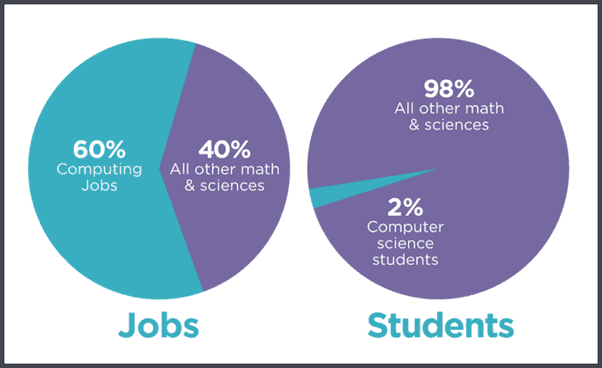
According to estimates, by 2020 there will be about one million more job openings than the number of graduates in this field.
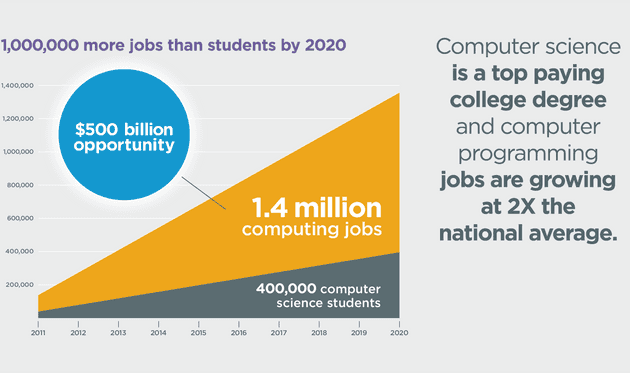
From these statistics we can draw two possible conclusions:
- You do not need a degree to work in IT, considering how much information is available online, and here I recommend the now famous article: You Don’t Need a College Degree to be a Software Developer!
- Given the strong demand and limited supply, salaries will be higher and the chances of building a successful career in this field will naturally be greater.
By now it is as clear as daylight: the whole world is converging toward technology. Think about what people do every day: they constantly connect to the Internet from all kinds of devices, use applications, watch streaming content, share photos and feelings on social media, manage smart-home systems from an app, pay with their smartphone, and much more.
Take big companies such as Amazon, Apple, Netflix, and Airbnb. They keep growing. They create new jobs and therefore new opportunities. In just a few years, possible careers in IT have grown exponentially. We now find roles that barely existed before, such as:
Cloud Architect, IT Director, Senior System Designer, Front End Developer, Data Center Support Specialist, Senior Network Architect and many more! For the full list, I recommend reading List of Information Technology (IT) Job Titles.
We live in extraordinary times. Every day, when I read IT news, someone somewhere in the world has invented something new. This sector is growing faster than the companies that finance it.
Amazon had about 24,000 employees in 2010. Today:
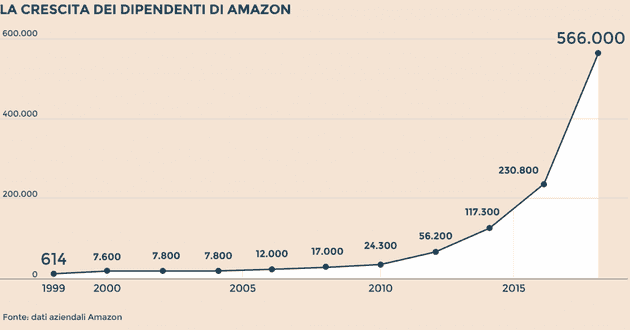
Impressive numbers, aren’t they?
The box is open now. This is a train moving at an incalculable speed. But know this: you can still get on board, and the moment is now.
Every day I see people who start studying from scratch with the goal of becoming a Front-end Developer or UX Developer, for example, and then leave their old job behind.
A new digital era has begun and the world is reacting. Look at the number of websites from 2000 until today:
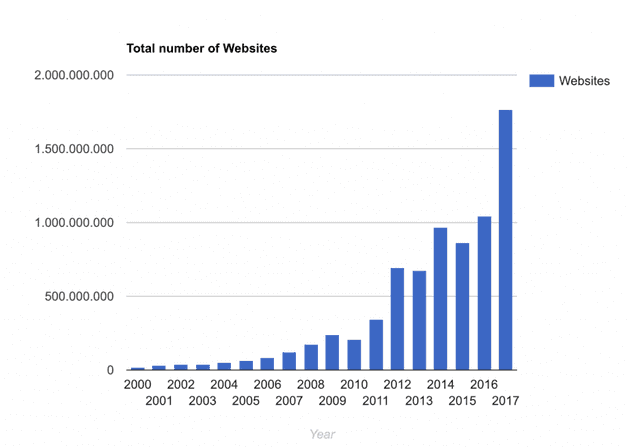
One day, the best programmers will be the rockstars of modern society and they will have highly prestigious salaries and roles. Computer science will dominate the whole world.
Everything will be digitized; it is only a matter of time. It is very important, however, to stay connected to reality. We need to know how to preserve ourselves in this great computing age. That is why I recommend reading my article: Survival Kit for Web Developers.